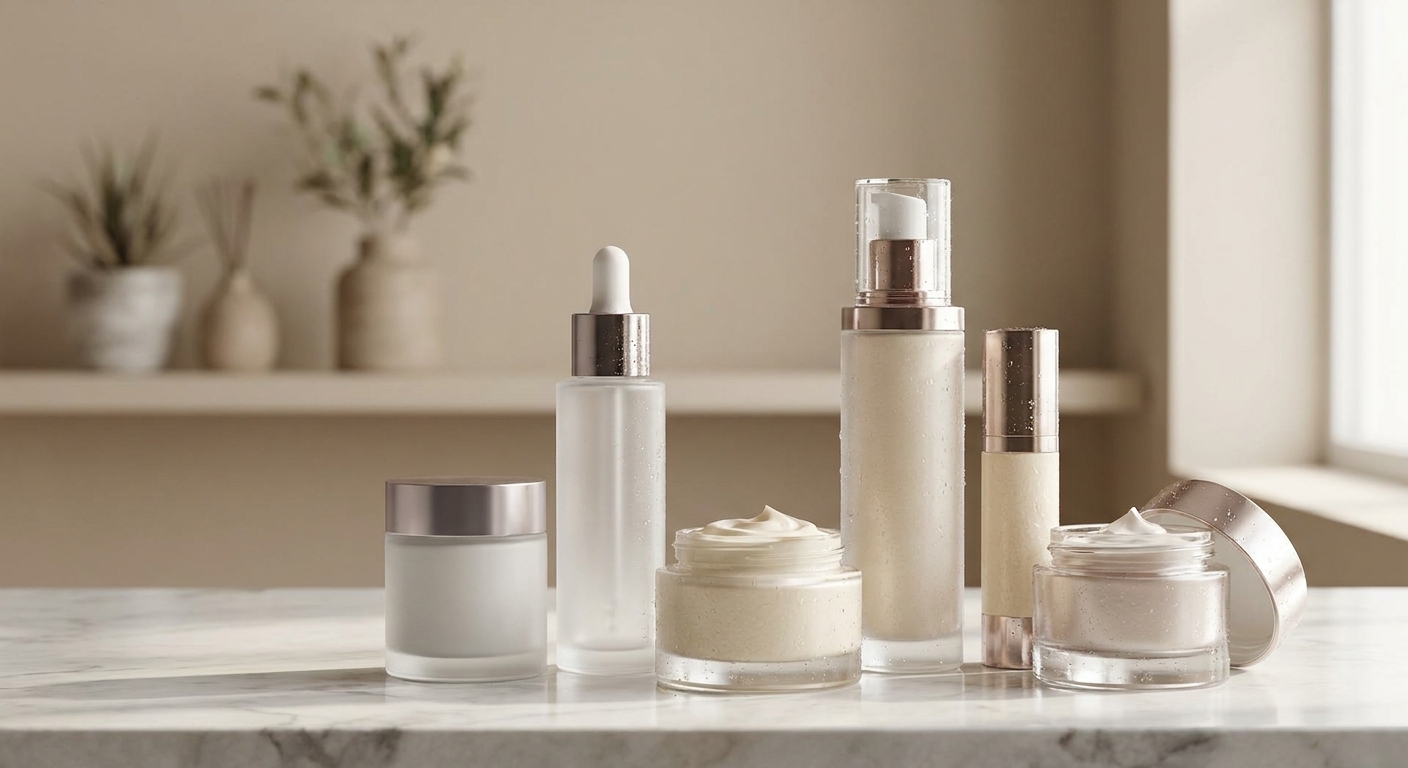
Luxury skincare brands lose sales at the product image, not the price point — buyers judge texture, purity, and quality from a JPEG before they ever open the jar. This guide breaks down what cosmetic product photography actually needs to do for a premium skincare line in 2026, and which shot types are worth the budget.
- Hero packaging shots at 4000px minimum are non-negotiable for luxury skincare in 2026 — buy.
- Macro texture and swatch shots close more sales than flat lays for cosmetic product photography — buy.
- Generic prop-heavy flat lays read cheap on premium skincare packaging — skip.
- Before/after skin shots need model releases and restrained retouching or they get flagged by ad platforms — consider.
- Courtney Dailey Photography shoots luxury skincare, makeup, and fragrance campaigns from Los Angeles.
Why this matters
A skincare buyer scrolling Instagram or Sephora.com decides in under two seconds whether a product looks worth $80 or $18. Cosmetic product photography is the entire pitch at that moment — no founder story, no ingredient deck, just the image.
Brands that treat product photography as a checkbox end up with packaging shots that look fine on a laptop and fall apart at 4K resolution or on a billboard crop. Courtney Dailey Photography works specifically inside luxury skincare, makeup, and fragrance campaigns, which changes what "good enough" means — luxury shoppers scrutinize glass weight, cap finish, and liquid clarity in ways a mass-market shopper never does.
Who this is for
This guide is for marketing directors and founders at luxury skincare brands, plus the agencies buying photography on their behalf, who are choosing a shot list for a 2026 launch or seasonal refresh. If your price point sits above $40 a unit and your packaging uses glass, metal caps, or matte-finish tubes, the criteria below apply directly to you.
What to look for in cosmetic product photography for luxury skincare brands
Color accuracy on the actual formula
Skincare buyers scrutinize color more than almost any other beauty category — a serum that photographs amber instead of pale gold reads as expired or off-brand. Color that's off by even a shade under studio lighting will look worse under a phone screen's blue-shifted white balance, which is where most buyers actually view the image.
Resolution built for reuse, not just the current placement
A shot commissioned for a 1080px Instagram post has no life left in it when the brand needs a trade show banner or an in-store display six months later. Files delivered at 4000 pixels on the long edge or larger cover print, paid social, and packaging mockups from one shoot day.
Texture and finish rendering
Luxury skincare sells on sensory cues — the matte drag of a cream, the shine of a serum bead, the frost on a chilled eye gel. A photographer who understands macro lighting for skin-adjacent textures captures that; a generalist product shooter flattens it into a shiny blob.
Packaging material handling
Glass, brushed metal, and matte soft-touch plastic each bounce light differently, and a single lighting setup rarely flatters all three. Reflective glass needs polarized lighting or it picks up studio equipment in the reflection — an amateur mistake that's instantly visible to a trained eye.
Consistency across a full campaign set
A launch rarely ships with one hero image — it needs a hero shot, a texture shot, a lifestyle context shot, and often a flat lay for retail listings. Consistency in white balance and shadow direction across that whole set matters more than any single image being spectacular.
Usage rights that match your media plan
A shoot day means nothing if the licensing terms only cover organic social and the brand later wants to run paid ads or license images to a retail partner. Confirm the usage scope in writing before the shoot, not after the invoice.
The shot list: what to prioritize
Hero packaging shot on seamless — the workhorse. Shot on white or black seamless with the bottle or jar isolated, delivered at 4000px minimum so it survives print and paid ad crops alike. This is the image that ends up on the product detail page and the retail listing. Buy.
Texture and swatch macro — the proof shot. Close-focus imagery at roughly 1:1 magnification showing the cream's drag, the serum's viscosity, or the powder's finish. This is the shot that answers "what does it actually feel like" for an online-only buyer. Buy.
Lifestyle application context — the wildcard. Hand or skin application shots that show scale and use-case without becoming a full beauty campaign. Useful for email and paid social, less critical for the retail listing itself. Consider.
Prop-heavy flat lay — the trend chaser. Popular a few years ago, now reads as generic stock imagery on a luxury product page, especially when competitors are running clean seamless hero shots. Budget toward the hero and texture shots first. Skip unless a specific retail partner requires it.
Before/after skin comparison — needs the most oversight. Requires signed model releases and restrained retouching, since overly smoothed "after" images get flagged by Meta and Google ad review teams in 2026. Worth it for efficacy-driven skincare lines, risky for anything else. Consider.
Plan your 2026 skincare campaign shoot
Los Angeles-based photography for luxury skincare, makeup, and fragrance brands.
What to avoid
- Uncalibrated color on the actual product — a serum shot under warm tungsten light without a gray-card correction will drift toward yellow, and a returns spike from "doesn't match photos" complaints usually traces back to this.
- Over-retouched glass and metal — cloning out every reflection on a glass dropper bottle makes it look like a 3D render instead of a real product, which undercuts the tactile, premium feel luxury skincare buyers expect.
- One-size shot lists — the same five images reused across product detail page, paid ad, and retail partner listing without resizing for each platform's crop ratio; a hero shot framed for a square Instagram post gets awkwardly cropped on a vertical product page.
Verdict comparison
| Shot type | Best use | Resolution needed | Verdict |
|---|---|---|---|
| Hero packaging (seamless) | Product page, retail listing | 4000px+ | Buy |
| Texture/swatch macro | Paid social, PDP secondary image | 3000px+ | Buy |
| Lifestyle application | Email, paid social | 2500px+ | Consider |
| Prop-heavy flat lay | Legacy retail requirement only | 2500px+ | Skip |
| Before/after skin | Efficacy-driven claims | 3000px+ | Consider |
FAQ
What's the best cosmetic product photography style for luxury skincare in 2026?
A hero packaging shot on seamless white or black paired with a texture macro shot covers the two highest-converting formats for luxury skincare in 2026. Lifestyle application shots add context but aren't the core sell.
Is macro texture photography necessary for skincare packaging?
Yes, for any skincare product where texture is part of the pitch — creams, balms, and serums especially. A texture macro shot answers the "what does this feel like" question that a packaging shot alone can't.
How much does luxury skincare product photography cost in 2026?
Cost depends on the shot list length, usage license scope, and number of SKUs in a single shoot day. Get a quote based on the specific deliverables your campaign needs rather than a flat industry rate.
Do luxury skincare brands need video alongside product stills?
Not always — many campaigns launch on stills alone and add video for a paid social phase later. Stills remain the foundation for the product detail page and retail listings regardless.
How long does a cosmetic product photography shoot take?
A single-SKU shoot covering hero, texture, and lifestyle shots typically fits into one studio day. Multi-SKU campaigns with several formulas or packaging variants run longer depending on the shot count.
What's the difference between beauty photography and cosmetic product photography?
Beauty photography usually features a model wearing or applying the product, while cosmetic product photography focuses on the packaging, texture, and formula itself. Luxury skincare campaigns typically need both.
Does a luxury skincare brand need a Los Angeles-based photographer?
Not strictly, but working with a photographer local to major beauty markets like Los Angeles often means faster access to studio space, prop sourcing, and talent for lifestyle shots. Courtney Dailey Photography shoots luxury skincare, makeup, and fragrance campaigns from Los Angeles.
Can one shoot's images be reused across ads and packaging?
Yes, as long as the files are delivered at high enough resolution (4000px or more on the long edge) and the licensing terms cover both uses. Confirm usage scope before the shoot, not after delivery.
One last thing
The detail most brands skip: check your hero shot at 100% zoom on a 4K monitor before it goes live. A file that looks sharp on a phone screen often reveals soft focus or compression artifacts at full resolution — exactly the crop a retail partner or print vendor will pull in 2026.
Cosmetic product photography for a luxury skincare line isn't about volume of images — it's about the right five shots, delivered at resolution that survives every placement you'll need this year and next.