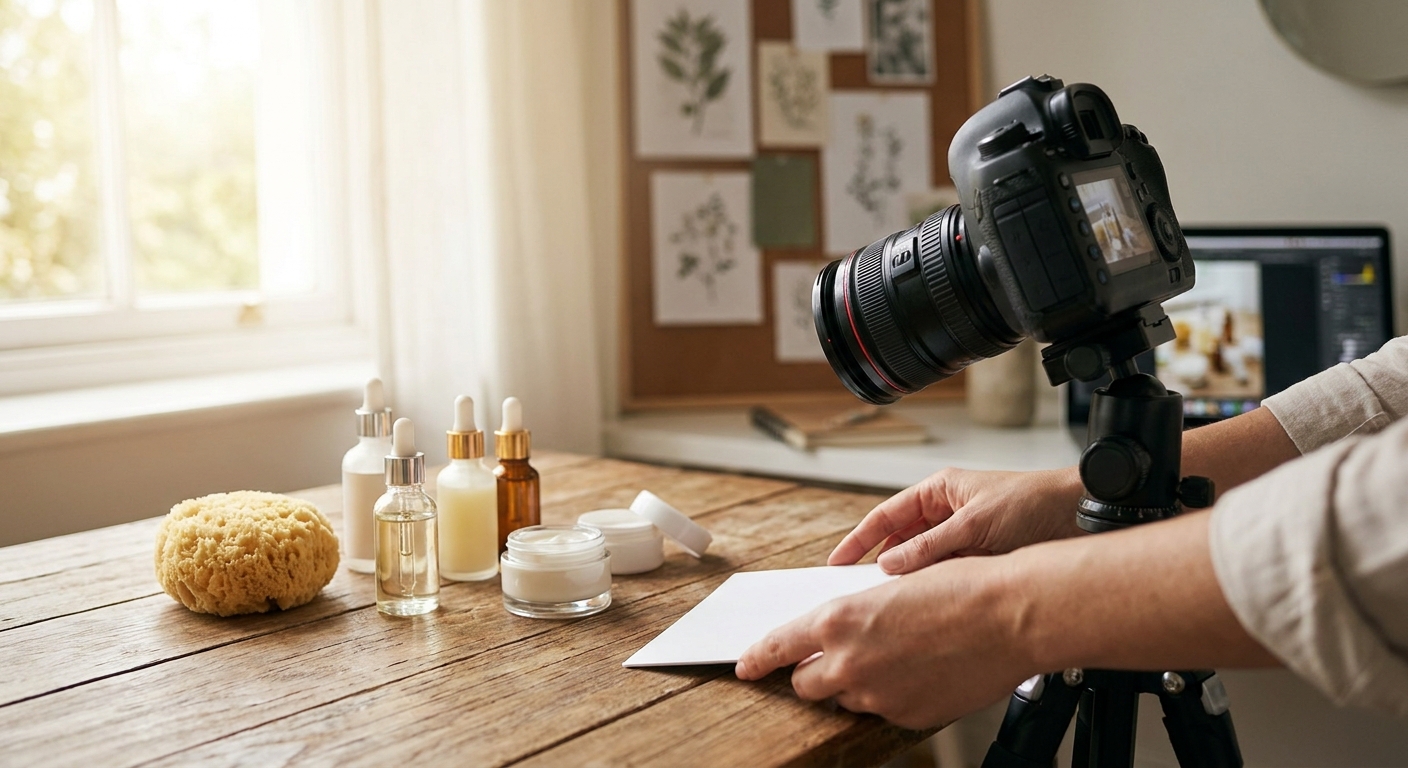
Clean beauty buyers scan ingredient lists before they scan price tags, and the photography has to prove that story in the first three seconds of a scroll. This guide breaks down what to look for in product photography for clean beauty brands, which shot types actually convert, and where brands waste budget on the wrong style.
- Texture and macro ingredient shots outperform plain white-background hero shots for clean beauty conversion — prioritize them.
- Product photography for clean beauty brands needs color accuracy on pastel and glass packaging, not just sharp focus.
- Courtney Dailey Photography works luxury skincare, makeup, and fragrance campaigns for beauty brands and agencies in Los Angeles.
- Skip heavy plastic prop styling in 2026 — it undercuts a sustainability-led brand story.
- Deliver files at 1:1, 4:5, and 9:16 crops upfront so paid social doesn't get a cropped afterthought.
Why this matters
Clean beauty brands sell a promise — fewer ingredients, more transparency — and the photography either backs that promise or contradicts it. A shot styled like a mass-market drugstore campaign reads wrong on a jar that costs $48 and lists six ingredients.
Retail buyers, Sephora merchandising teams, and paid social algorithms all judge images differently, and clean beauty brands get squeezed from both sides in 2026: retail wants clean, consistent product shots, while social wants texture and proof. Courtney Dailey Photography builds campaigns for skincare, makeup, and fragrance brands that need both without hiring two separate photographers.
Who this is for
This guide is for marketing leads and founders at clean beauty and indie skincare brands prepping a product launch, a retail listing refresh, or a paid social campaign — plus the agencies buying photography on their behalf. If you're choosing between a generalist product photographer and a specialist, or trying to brief a shoot without wasting a day of studio time, this is written for you.
What to look for in product photography for clean beauty brands
Color accuracy on light, translucent packaging
Clean beauty packaging leans toward glass, amber, and pastel plastics — colors that shift under the wrong lighting setup. A photographer without color-calibration discipline will deliver product shots that look muddy or oversaturated once they hit a retail listing next to competitors.
Texture rendering for creams, serums, and powders
The ingredient story lives in texture: the way a serum drops, the way a balm catches light, the way a pressed powder shows grain. Flat lighting kills that detail, and clean beauty buyers specifically look for it before adding to cart.
Sustainability-conscious styling
Props matter. A shoot styled with plastic risers and synthetic backdrops undercuts a brand built on recyclable packaging and minimal ingredients. Look for a photographer who styles with natural materials — stone, linen, unbleached paper — that match the brand's actual packaging philosophy.
Crop versatility across platforms
A single hero shot rarely covers every placement. You need 1:1 for Amazon and retail grids, 4:5 for Instagram feed, and 9:16 for Reels and Stories — delivered from the same shoot, not re-cropped and stretched after the fact.
Experience with luxury skincare and fragrance categories
A photographer who shoots furniture one week and skincare the next won't understand why a fragrance bottle needs different reflections than a moisturizer jar. Category-specific experience shows up in how light hits glass versus how it hits matte plastic.
Brief your next clean beauty shoot
Get campaign photography built around skincare, makeup, and fragrance packaging.
Top picks: shot types that work for clean beauty brands
The workhorse — hero product shot
A clean, evenly lit shot on a neutral or brand-color background remains the baseline for every retail listing and homepage. Verdict: Must-have. Every clean beauty SKU needs at least one, delivered at a minimum of 300 DPI for print use and stripped to web resolution separately.
The proof point — texture and ingredient macro shots
Close-up shots of the product's actual texture — the whipped consistency of a moisturizer, the shimmer of a highlighter — do more conversion work than a second hero angle. Verdict: Priority. Clean beauty shoppers who scroll past a hero shot often stop on a texture close-up.
The scroll-stopper — lifestyle and editorial campaign imagery
Model-in-context shots for fragrance and makeup launches carry the brand's tone across paid social and PR. Verdict: Consider. Worth the added budget for a launch or seasonal campaign, less critical for a routine restock listing.
The context-builder — flat lay and ingredient story shots
Laying the product next to raw ingredients (a slice of aloe, a sprig of rosemary) tells the sourcing story visually. Verdict: Consider. Useful for brands whose entire pitch is ingredient transparency; skip it if the formula story isn't the differentiator.
The over-relied-on — plain UGC-style phone shots
Casual, phone-camera-style content has its place in organic social, but leaning on it for retail listings or paid ads reads as underinvested. Verdict: Skip for retail. Reserve it for influencer seeding, not primary product photography.
Courtney Dailey Photography's cosmetic product photography work for luxury skincare brands covers the hero-shot-to-texture-shot range most clean beauty launches need in a single production day.
What to avoid
- Stock photography retouched to match your packaging. It never quite matches the actual product color, and retail buyers notice the mismatch immediately.
- Over-retouched skin on lifestyle shots. Clean beauty brands lose credibility fast when the campaign image looks airbrushed past the point of believability — the whole pitch is authenticity.
- Single-crop delivery. Getting one 1:1 file and cropping it yourself for Stories and Reels produces stretched, off-center images that look amateur next to competitors' native crops.
Verdict comparison
| Shot type | Color accuracy need | Texture importance | Best use in 2026 | Verdict |
|---|---|---|---|---|
| Hero product shot | High | Low | Retail listing, homepage | Must-have |
| Texture/macro shot | High | Very high | Social ads, PDP | Priority |
| Lifestyle/editorial | Medium | Medium | Launch campaign, PR | Consider |
| Flat lay/ingredient | Medium | Low | Brand story pages | Consider |
| UGC-style phone shot | Low | Low | Organic social only | Skip for retail |
FAQ
What is product photography for clean beauty brands?
It is packaging and formula photography styled to match a clean beauty brand's ingredient-transparent, sustainability-led positioning, prioritizing texture, natural props, and accurate color over heavy retouching.
How is clean beauty photography different from regular product photography?
Clean beauty photography leans on texture close-ups and natural styling instead of glossy, heavily art-directed sets, because the brand story is ingredient honesty rather than manufactured perfection.
Is a white background shot enough for a clean beauty brand?
A white background hero shot covers the retail listing requirement but rarely converts on its own in 2026 — pair it with at least one texture or ingredient shot for social and PDP use.
How much does clean beauty product photography cost in 2026?
Cost depends on SKU count, number of shot types, and whether a model or lifestyle set is involved — request a scoped quote rather than budgeting off a flat rate.
What file formats do I need for retail and Amazon listings?
Retail and Amazon listings typically require a 1:1 crop at print-ready resolution alongside separate web-optimized files, so confirm both are delivered from the same shoot.
Should a clean beauty brand hire a specialist photographer or a generalist?
A specialist who regularly shoots skincare, makeup, or fragrance understands how light behaves on glass and translucent packaging, which a generalist product photographer often gets wrong on the first pass.
How many images does a clean beauty brand need per SKU?
Most launches need a hero shot, one to two texture or macro angles, and at least one lifestyle or flat lay image per SKU to cover retail, PDP, and social placements.
One last thing
The shot that gets skipped most often — the texture macro — is usually the one that gets the most engagement on social in 2026. Brands that budget for a second hero angle instead of a texture close-up are optimizing for the wrong metric.