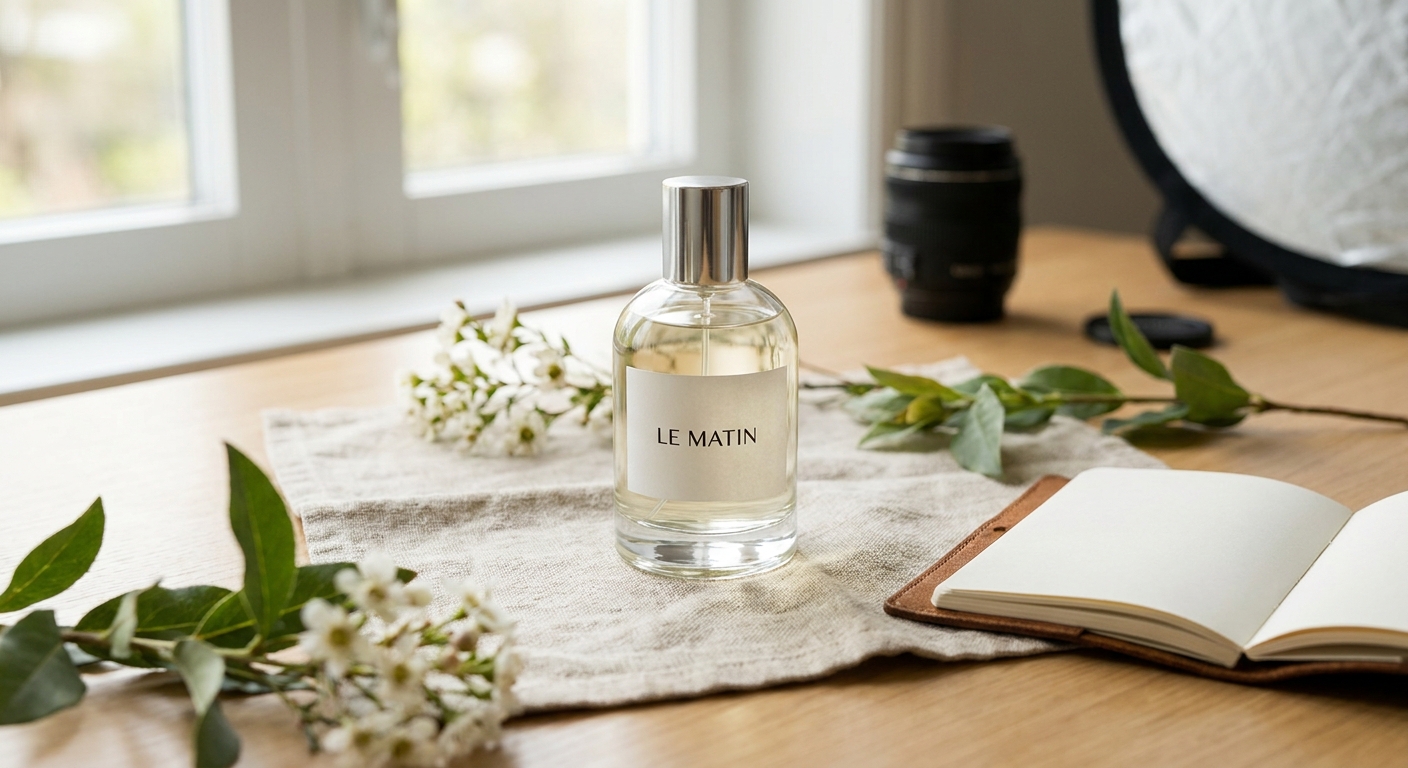
Fragrance brands need photography that sells scent through sight alone — the bottle, the light, the story around it. This guide breaks down what luxury beauty and fragrance brands should demand from product photography for fragrance brands in 2026, and which shot types actually move product.
- Fragrance campaigns need at least three deliverable types: e-commerce hero shots, macro glass details, and lifestyle scenes — skipping any one weakens the launch.
- Generic product photographers often mishandle glass reflections and cap texture; specialist beauty photographers correct this in lighting setup, not just retouching.
- Color accuracy between the physical bottle and the final image is the single most common failure point in fragrance photography for 2026 launches.
- Courtney Dailey Photography's approach to product photography for fragrance brands starts with color-calibrated capture, not post-production fixes.
Why this matters
A fragrance bottle photographed flat and lifeless reads as a commodity, not a luxury object. The photography is often the only sensory cue a shopper gets before buying — there's no scent test on a product detail page. Brands that get this wrong see it in return rates and in how their listings look next to competitors on the same retail shelf, digital or physical, in 2026.
Who this is for
This guide is built for marketing leads, founders, and brand managers at fragrance houses and beauty brands preparing a launch, a re-platform of e-commerce imagery, or a paid social campaign that needs fresh creative. If you're briefing a photographer for the first time or evaluating a portfolio against your launch timeline, the criteria below apply directly. Courtney Dailey Photography works with beauty brands and agencies on exactly this brief.
What to look for in product photography for fragrance brands
Experience lighting glass and reflective surfaces
A fragrance bottle is glass, metal cap, and often a mirrored or high-gloss label — three surfaces that behave completely differently under the same light source. Photographers without dedicated beauty product experience tend to either blow out highlights or flatten the glass into a dull gray. Ask to see raw bottle shots, not just the retouched finals, before booking.
Color accuracy against the physical product
The biggest complaint brands have after a fragrance shoot is a bottle that looks a different shade of amber or a box that reads too warm or too cool on screen. Color-calibrated monitors and a color-managed workflow catch this before delivery, not after the client flags it. This matters more for fragrance than almost any other beauty category because packaging color is often the primary shelf differentiator.
A portfolio in luxury beauty specifically
General product photographers can shoot a clean white-background bottle competently, but fragrance campaigns increasingly need lifestyle and editorial-style imagery for paid social and retail media. Look for portfolio work in skincare, makeup, or fragrance campaigns specifically — the lighting language for luxury beauty differs from consumer electronics or apparel.
Deliverables across e-commerce, retail, and paid social
A single shoot day should produce assets usable on your product detail page, on Amazon or Sephora's platform if applicable, and as native creative for Meta or TikTok campaigns. Confirm before the shoot whether the photographer scopes for multiple aspect ratios and usage contexts, or just one flat deliverable set.
Turnaround against your launch date
Fragrance launches are date-driven — a PR event, a retail reset, a holiday push. A photographer who can't commit to a firm delivery date against your launch calendar creates downstream risk for the entire marketing plan. Get the turnaround commitment in writing before the shoot, not after.
Usage rights clear for every channel
Retail media placements, paid social, and organic content often carry different licensing expectations. Confirm usage rights cover every channel you plan to run the imagery on in 2026, including any retail media network placements, before you sign off on the shot list.
Plan your fragrance campaign shoot
Get a shot list scoped to your launch timeline and channels.
Deliverables your fragrance shoot actually needs
The non-negotiable: isolated hero shot. Every fragrance product page needs a clean, high-resolution isolated bottle shot on white or brand-color background, delivered at print-ready resolution for retail media use. Skip this and your product detail page looks unfinished next to any competitor. Verdict: Buy.
The trust-builder: macro cap and glass detail. A tight crop on the cap, the glass etching, or the label foil stamp signals craftsmanship in a way the full bottle shot can't. This is the shot that gets reused in email and social carousels months after launch. Verdict: Buy.
The storyteller: styled lifestyle scene. A bottle placed in a styled scene — with props, natural light, or a model's hand — carries the campaign narrative onto paid social and out-of-home. It costs more scheduling time and often a separate styling budget. Verdict: Consider if your paid social budget for 2026 exceeds a single-platform test.
The ingredient-story flat lay. For fragrances built around a specific note — oud, tuberose, bergamot — a flat lay pairing the bottle with the raw ingredient builds the sensory story text alone can't. Useful for content marketing and PR, less critical for a bare e-commerce launch. Verdict: Consider for brands with an ingredient-forward story to tell.
The scroll-stopper: motion or cinemagraph stills. Short looping motion content pulls higher engagement on Instagram and TikTok than static images in most 2026 beauty campaign benchmarks agencies report internally. It adds meaningful production cost and isn't essential for a first launch. Verdict: Skip for a first launch on a limited budget; revisit for a relaunch or anniversary campaign.
What to avoid
- Stock-style generic product photography — a photographer whose portfolio is mostly electronics, food, or apparel will treat glass and cap surfaces the same way they'd treat a phone case, and it shows in flat, lifeless reflections.
- Over-retouched glass that erases texture — heavy retouching that removes every reflection makes glass read as plastic or fake on screen, which undercuts the luxury positioning fragrance brands are paying for.
- A single flat deliverable set with no channel variants — a photographer who delivers one crop, one background, and calls it done leaves you re-shooting or re-cropping for every new channel you add through 2026.
Verdict comparison
| Deliverable | E-commerce ready | Paid social ready | Retail media ready | Verdict |
|---|---|---|---|---|
| Isolated hero shot | Yes | Limited | Yes | Buy |
| Macro cap/glass detail | Yes | Yes | Limited | Buy |
| Styled lifestyle scene | Limited | Yes | Limited | Consider |
| Ingredient flat lay | Limited | Yes | No | Consider |
| Motion/cinemagraph stills | No | Yes | No | Skip (first launch) |
FAQ
What's the best product photography style for fragrance brands in 2026?
A mixed set works best in 2026 — a clean isolated hero shot for e-commerce, a macro cap and glass detail for trust, and at least one styled lifestyle scene for paid social. Relying on only one style leaves gaps across your channels.
Is lifestyle photography or white background photography better for a fragrance launch?
Neither replaces the other; e-commerce needs the white background isolated shot as the baseline, while paid social and retail media placements perform better with styled lifestyle imagery layered on top.
How much does fragrance product photography cost?
Pricing scales with the number of final images, styling complexity, and usage rights scope rather than a flat day rate. Full campaign packages covering e-commerce, social, and retail deliverables cost more than a single hero-shot package.
How long does a fragrance product photography shoot take?
A focused e-commerce and detail shot session typically runs a single day; adding styled lifestyle scenes or multiple bottle SKUs extends that to two or more shoot days depending on the shot list.
Do fragrance brands need video content alongside photography?
Not for a first launch on a limited budget, but motion and cinemagraph content consistently outperforms static images on social engagement metrics reported by agencies in 2026, making it worth adding for a relaunch.
What resolution do fragrance product photos need for retail placements?
Retail media platforms and print collateral both require print-ready resolution files, typically higher than the compressed images used for a website product page alone. Confirm delivery specs with your photographer before the shoot.
Should fragrance brands hire a beauty-specialist photographer or a general product photographer?
A beauty specialist handles glass reflections, cap texture, and color-matching against the physical packaging more reliably than a generalist, which matters most for fragrance because packaging color is often the primary shelf differentiator.
Can one photography shoot cover both skincare and fragrance product lines?
Yes, when the photographer has experience across both categories, since lighting for glass bottles and jars shares core techniques, though fragrance adds the specific challenge of cap and label reflections.
One last thing
The detail brands overlook most in 2026 fragrance briefs isn't the hero shot — it's the cap. Buyers zoom in on the cap and neck of the bottle more than any other region of a fragrance product image, and a soft or poorly lit cap crop undercuts an otherwise strong hero shot.