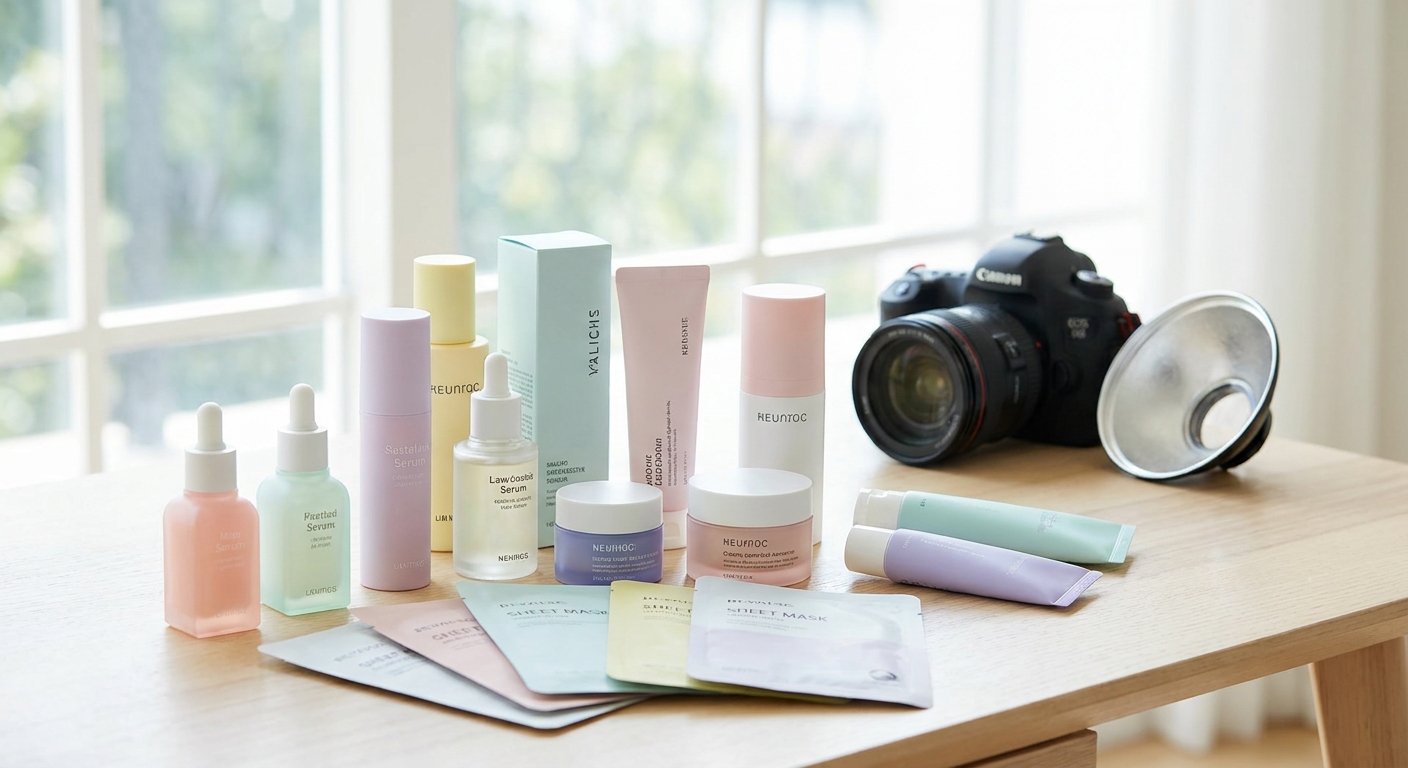
K-beauty brands selling into the US market face a photography problem their Korean marketing teams never had to solve: American retailers, Amazon listings, and Instagram feeds all demand different image specs, and getting it wrong stalls a launch. This guide breaks down what to shoot, what to skip, and which formats actually move product for K-beauty brands entering or scaling in the US in 2026.
- Studio hero shots on pure white are non-negotiable for Amazon and Sephora listings in 2026 -- include them for every SKU.
- Macro texture shots sell essences and ampoules better than lifestyle photography for K-beauty brands with hero ingredients.
- Skip 360-degree spin photography unless an Amazon A+ content plan already calls for it -- it rarely earns back its cost.
- Courtney Dailey Photography treats color accuracy on pastel and glass packaging as the first filter for any K-beauty shoot.
Why this matters
K-beauty packaging is built around pastel gradients, frosted glass, and holographic foil -- all things a standard e-commerce photography setup gets wrong. A cushion compact photographed under the wrong lighting turns pink-beige into gray. An ampoule bottle loses the exact translucency that signals "lightweight" to a US shopper who's never touched the product before buying it.
Get product photography for K-beauty brands wrong and the damage shows up in return rates and stalled conversion, not just in how the image looks on a monitor. Get it right and one shoot covers Amazon, Sephora, Ulta, and paid social without a reshoot.
Who this is for
This guide is for marketing leads at Korean skincare, makeup, and fragrance brands launching or expanding in the US, and for agencies managing that launch on the brand's behalf. If you're choosing between an in-house shoot, an offshore studio, and a specialized product photography partner, the criteria below apply whether you're shooting three SKUs or thirty.
What to look for in product photography for K-beauty brands
Color accuracy on pastel and glass packaging
K-beauty packaging leans on soft pastels, frosted glass, and metallic caps -- all of which shift under uncalibrated lighting. A photographer who color-checks against the physical product, not just a screen preview, catches the drift before it reaches a product page. This matters more for K-beauty than for most Western skincare lines because the palette sits in a narrower, harder-to-reproduce range.
Texture and swatch capture
Essences, ampoules, and cushion foundations sell on texture -- viscosity, glide, finish. A shooter without macro lighting experience shoots the bottle and misses the thing that actually convinces a US buyer to trust an unfamiliar brand. Ask to see texture or swatch work from a past skincare or cosmetics campaign before booking.
Retouching restraint
US beauty consumers in 2026 are more skeptical of over-retouched product images than they were five years ago, and K-beauty audiences specifically expect ingredient transparency. A photographer who smooths out every surface reflection on a serum bottle erases the exact cue -- viscosity, clarity -- that sells the product.
US retail compliance
Amazon requires a pure white background and a minimum 1000-pixel main image (2000x2000px recommended for zoom function); Sephora and Ulta each run their own separate spec sheets. A photographer who's shot for US retail before delivers files that pass review the first time instead of bouncing back for a reshoot two weeks before launch.
Turnaround for multi-SKU launches
K-beauty launches often land 8-15 SKUs at once -- a full line, not a single hero product. Ask how a shoot is sequenced for that volume before booking, because a photographer used to single-product shoots for Western brands may not have a workflow built for it.
Planning a K-beauty product launch
See studio and campaign work for skincare, makeup, and fragrance brands.
Formats to include -- and what each one actually does
Studio hero shots -- the essential. Pure white or light gradient background, one product per frame, shot at a minimum of 2000x2000px for Amazon zoom compliance. Every SKU needs this format regardless of price point or category. Include.
Macro texture shots -- the wildcard. Close-up captures of essence viscosity, cushion compact swirl, or glass refraction on an ampoule bottle. This format does more to convert a first-time US buyer on an unfamiliar K-beauty brand than a clean studio shot alone. Include for hero SKUs.
Flat lay or packaging spread -- the safe pick. A full line laid out in one frame, useful for press kits and Instagram grid posts; fits 6-8 SKUs comfortably in a single composition. This is where luxury skincare product photography work translates directly -- the same discipline that makes a serum line look premium applies to a K-beauty line. Include for full launches.
Lifestyle campaign imagery -- the splurge. Hands, models, or environmental staging around the product; runs a higher day rate than studio-only work. Worth it for paid social and hero-product campaigns, less necessary for a full 15-SKU catalog shoot. Consider for flagship SKUs.
360-degree spin photography -- the niche pick. A 24-36 frame rotating sequence, mainly used for Amazon A+ content modules. Costs more per SKU than any other format here and rarely earns it back unless the Amazon listing strategy already calls for it. Skip unless already planned.
What to avoid
- Generic stock-style photographers with no US retail history. A photographer who's never delivered files against Amazon or Sephora specs will hand back images that get rejected in review, costing a launch a week or more.
- Over-retouched glass and packaging. Smoothing out every reflection on a K-beauty ampoule or glass jar removes the exact texture cue that signals product quality to a skeptical buyer.
- Skipping color calibration on pastel packaging. A brand's signature pink-beige or mint packaging that looks slightly "off" across five different retail channels reads as inconsistent, not premium.
Verdict comparison
| Format | Best for | Turnaround weight | Verdict |
|---|---|---|---|
| Studio hero shot | Every SKU, Amazon/Sephora listings | Low per SKU | Include |
| Macro texture shot | Essences, ampoules, cushion compacts | Medium | Include for hero SKUs |
| Flat lay / packaging spread | Full-line launches, press kits | Medium | Include for launches |
| Lifestyle campaign | Paid social, flagship SKUs | High | Consider |
| 360-degree spin | Amazon A+ content only | High | Skip unless planned |
“If a product photo doesn't survive being cropped down to a thumbnail, it won't survive an Amazon search results page.”
FAQ
What does product photography for K-beauty brands cost in 2026?
Cost varies by SKU count and format mix -- studio hero shots run lower per unit than macro texture or lifestyle work, and full multi-SKU launches typically get quoted as a package rather than per image. Ask for a quote scoped to the exact SKU count and format list before comparing rates.
Is US-based photography better than outsourcing to Korea for US market launches?
A US-based photographer who already knows Amazon, Sephora, and Ulta image specs avoids the reshoot risk that comes with files shot to a different retailer's standard. That's less about location and more about which retail specs the photographer has actually delivered against before.
How many product photos does a K-beauty brand need per SKU?
Most SKUs need at least one compliant studio hero shot plus one or two supporting angles for retail listings; hero products in a line often add a macro texture shot on top of that. A full 8-15 SKU launch multiplies from there depending on channel mix.
What's the difference between e-commerce and campaign photography for skincare?
E-commerce photography is built to retail spec -- white background, specific pixel dimensions, compliance-first. Campaign photography for skincare adds styling, lighting mood, and sometimes models or hands, built for paid social and brand storytelling rather than listing compliance.
How long does a K-beauty product photography shoot take?
A single-SKU studio shoot can wrap in a few hours; a full multi-SKU launch with texture and lifestyle formats added typically runs a full day or spans multiple days depending on the format mix and SKU count.
Do Amazon and Sephora require different image specs?
Yes -- Amazon requires a pure white background and a minimum pixel dimension (2000x2000px recommended for zoom), while Sephora and Ulta each run their own separate submission guidelines. Files shot to one retailer's spec often need adjustment before they pass another's review.
Should K-beauty brands use lifestyle or studio-only photography?
Studio shots are required for retail listings regardless of budget; lifestyle imagery is an addition for paid social and flagship-product storytelling, not a replacement. Most launches need both, weighted toward studio for full-catalog coverage.
How far in advance should a K-beauty brand book a photographer?
Book 3-6 weeks ahead of a launch date for a multi-SKU shoot to leave room for retoucher turnaround and a reshoot buffer if any file gets rejected on retail spec review.
One last thing
The format brands skip most often is the macro texture shot -- and it's usually the one that should have come first. A K-beauty brand's whole value proposition rides on ingredient and texture cues that a studio hero shot on white simply can't carry alone, and Courtney Dailey Photography treats that shot as a standard deliverable for skincare and cosmetic campaigns, not an upsell.