Yes, beauty product photography can be shot without a stylist when the images use straightforward product arrangements and someone is explicitly responsible for preparation, placement, and continuity. The caveat is that removing a dedicated stylist does not remove the styling work: your photographer or brand team still needs to handle it. For a 2026 shoot, make the decision from the required images, not simply from the crew list.
- Can beauty product photography be shot without a stylist? Yes, when product preparation, placement, and continuity have clear owners.
- Simple skincare packshots suit a smaller crew; intricate cosmetic textures and fragrance arrangements need more styling attention.
- Courtney Dailey Photography specializes in beauty campaigns and cosmetic product photography for beauty brands and agencies.
- Approve a representative setup before extending a stylist-free approach across the shot list.
Can beauty product photography be shot without a stylist?
Yes for simple, controlled setups; use a dedicated stylist when physical arrangement is a substantial part of the creative work. A closed skincare bottle on a plain surface creates a different styling task from an open jar surrounded by precisely shaped cream textures. Treat those as different production requirements, even when they appear in the same campaign.
Record those requirements in your beauty photographer campaign brief. Specify what must appear in the image, what needs physical preparation, and who approves the result before the setup changes.
| Production approach | Best for | Advantage | Limitation |
|---|---|---|---|
| Photographer-led styling | Straightforward packshots and restrained arrangements | Keeps lighting and placement decisions together | Preparation competes with the photographer's attention to lighting and capture |
| Brand-led styling | Shoots where a brand representative can prepare and arrange products | Keeps packaging and presentation decisions close to the brand | Requires a representative who can execute, not just approve |
| Dedicated product stylist | Texture-led images, detailed prop arrangements, and repeatable physical effects | Gives preparation and continuity a clear specialist owner | Adds another role to coordinate and brief |
These approaches describe responsibility, not fixed service packages. Confirm the actual scope with everyone involved rather than assuming a photographer automatically includes styling.
Why this matters
An unattended fingerprint, inconsistent cap angle, or poorly shaped product texture changes the image you approve. Lighting cannot decide whether a cream swipe looks appropriate for your brand, and retouching should not become the default answer to unfinished preparation.
For beauty brands and agencies, the useful question is who owns the product's appearance between captures. Courtney Dailey Photography specializes in beauty campaign photography and cosmetic product photography; that specialty is relevant to your photographer shortlist, while the styling assignment still needs an explicit agreement.
In your 2026 production brief, separate creative approval from hands-on execution. Saying that the brand will approve styling does not identify who will clean the bottle, position the cap, or rebuild an arrangement.
Simple packshots: assign preparation before capture
Best for: closed packaging, plain backgrounds, and arrangements with few physical elements. A stylist-free shoot is a reasonable approach when the desired presentation is clear and someone on set can maintain it while the photographer works.
Write down the presentation rules before shooting. Include the visible label face, cap position, product orientation, and whether packaging appears alongside the container. A reference image helps, but written instructions make the intended details easier to check.
Use a 3-frame approval check: a front view, an angled view, and a close detail. This is a suggested review sequence, not a required industry standard. It tests whether the team agrees on the label, container shape, surface condition, and finish before repeating the setup.
The advantage is a focused production with fewer handoffs. The limitation is divided attention: if the photographer also prepares every item, preparation and capture become competing tasks. Assign a capable product handler rather than leaving that responsibility implicit.
Texture-led images: give the material a clear owner
Best for: a dedicated stylist when the texture itself carries the concept. Skincare swipes, cosmetic smears, and carefully placed droplets require decisions about shape, edge, placement, and consistency. Those decisions are styling work, even when no props appear.
Define what the texture needs to communicate visually without overstating product performance. A photograph can show a glossy surface or a dense-looking application; it should not imply an unsupported skincare result.
Before capture, agree on:
- Texture shape: the intended silhouette and edge treatment.
- Placement: where the material sits relative to the package.
- Continuity: which details must stay consistent across images.
- Reset ownership: who rebuilds the arrangement after a change.
A photographer-led approach still works when that responsibility is agreed and the execution fits the shoot. Its limitation is workload, not legitimacy. Do not mistake a minimal-looking final image for a minimal preparation task.
Fragrance and prop arrangements: judge the physical complexity
Best for: specialist styling support when the composition depends on detailed relationships between objects. A fragrance bottle alone and a fragrance bottle in a constructed scene need different preparation. Evaluate the arrangement rather than assuming every fragrance campaign needs the same crew.
List the elements that must remain controlled: bottle orientation, label visibility, prop position, surface condition, and the relationship between the product and its surroundings. Then identify which elements change between shots.
The advantage of a dedicated stylist is concentrated responsibility for those physical relationships. The limitation is an additional creative handoff: references still need to explain what belongs in the frame and why.
For a restrained arrangement, a prepared photographer-and-brand team can be sufficient. For an elaborate arrangement, assigning styling to whoever is free is not a production plan. Name the person responsible before committing to the setup.
Why the need for a stylist varies
The same beauty brand can need different staffing across its shot list. Use these factors to decide where styling support belongs instead of applying one rule to the entire campaign.
- Product condition: Closed, clean packaging involves different handling from open cosmetics or exposed textures.
- Arrangement complexity: A single upright product requires fewer placement decisions than a layered physical composition.
- Continuity demands: Repeated angles and related images require consistent orientation, spacing, and surface treatment.
- Creative ownership: Someone must resolve competing opinions about what the product should look like.
- Reset requirements: Every disturbed arrangement needs an owner who can restore the approved appearance.
- Assigned workload: Check whether the person handling styling also owns lighting, capture, approvals, or product tracking.
Use these factors in the 2026 shot-list review. Mark the images that involve substantive physical styling, then assign support to those images rather than treating the stylist as an automatic yes-or-no choice for the whole production.
How do you plan a shoot without a dedicated stylist?
A stylist-free beauty shoot needs explicit responsibilities, a representative approval, and a repeatable reset process. Follow this sequence before expanding the approach across your campaign.
1. Define the deliverables
Specify the views, crops, backgrounds, and physical arrangements you need. Separate a straightforward product view from a texture-led campaign image, even when both feature the same skincare item.
Avoid instructions such as making everything look luxurious without visual references. Describe the visible result: an upright bottle, a readable label, a clean surface, or a deliberate arrangement of packaging components.
2. Assign ownership
Name the person responsible for product preparation, physical placement, continuity, and approval. One person can hold several responsibilities, but each responsibility still needs to be acknowledged.
Use a 4-part responsibility check covering preparation, placement, continuity, and approval. This is a planning device: its purpose is to expose gaps, not prescribe a particular crew size.
3. Approve a test
Start with a representative setup rather than the simplest image by default. Include the material or arrangement most likely to reveal whether the proposed division of work is practical.
Review the image at the intended crop. Check the label, container edges, texture treatment, and relationship between objects before approving the setup for repeated use.
4. Record the setup
Keep a reference capture and concise notes about product orientation and placement. Record what must remain unchanged when products rotate through the scene.
A reference does not replace judgment. It gives the person handling continuity a specific target rather than an instruction to make the next image feel similar.
5. Reset consistently
Check the physical setup whenever the product or arrangement changes. Return to the approved reference before resuming capture, and escalate deliberate creative changes to the approval owner.
Do not let small departures accumulate unnoticed across a series. Consistency is an assigned task, not an automatic result of using the same lighting.
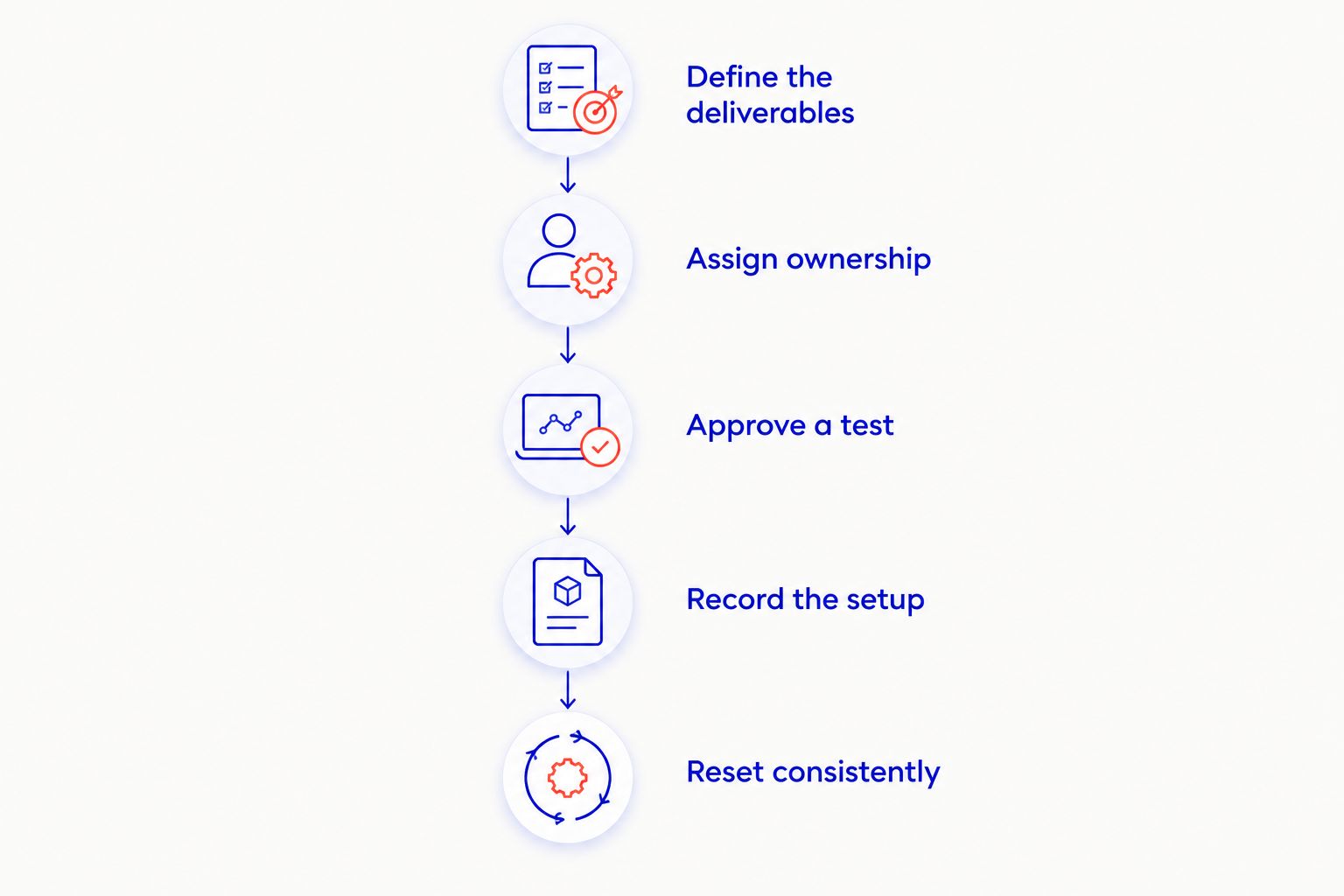
Keep this sequence in the 2026 production plan alongside the shot list. It gives your team a way to identify an overloaded role before that role becomes responsible for every unfinished detail.
Can the photographer also style beauty products?
Yes, a photographer can also handle product styling when that work is within the agreed scope and the setup is manageable. Photography and styling remain separate responsibilities even when the same person performs both.
Ask who prepares products while lighting is adjusted, who restores an arrangement between views, and who checks continuity. Those answers reveal more than a general promise that the team will handle everything.
Does removing the stylist remove styling work?
No, removing the stylist transfers the styling work to someone else. Product cleaning, placement, texture preparation, and continuity still need attention wherever they apply to the shot list.
Judge the smaller crew by its assigned responsibilities, not its headcount. A clear division of work is more useful than an unstaffed task hidden inside a shorter crew list.
When should a beauty brand add a stylist?
Add a stylist when preparing, maintaining, or rebuilding the physical arrangement becomes a substantial production task. Texture-heavy imagery and detailed prop compositions are clear points to examine during planning.
Approve the staffing decision against a representative setup. If the photographer must repeatedly stop capture to reconstruct the scene, revisit the division of work before extending that approach across the remaining images.
Choosing the right photography fit
Courtney Dailey Photography is best suited to beauty brands and agencies seeking beauty campaign and cosmetic product photography. The Los Angeles-based specialty includes luxury skincare, makeup, and fragrance campaigns, making the subject focus relevant to those briefs.
That specialty does not establish a particular crew configuration. Review the Courtney Dailey Photography portfolio against your intended imagery, then discuss which physical styling tasks belong in the production scope. Do not infer staffing or deliverables from the portfolio alone.
FAQ
Can beauty product photography be shot without a stylist?
Yes, beauty product photography can be shot without a stylist when someone explicitly owns preparation, placement, and continuity. Simple packshots are a clearer fit than intricate textures or detailed prop arrangements.
Do skincare packshots need a product stylist?
Skincare packshots do not automatically need a dedicated product stylist. They still need clean packaging, deliberate placement, and someone responsible for maintaining the approved appearance.
Can my brand team handle product styling?
Your brand team can handle product styling when an assigned person can execute the required preparation and arrangements. Creative approval alone does not cover hands-on styling work.
Is a product stylist the same as an art director?
A product stylist handles the physical presentation of products and related elements, while an art director guides the visual direction. Define responsibilities explicitly when one person covers both roles.
Should I hire a stylist for cosmetic texture photography?
Use a dedicated stylist when shaping and maintaining cosmetic textures is a substantial part of the concept. A simpler texture setup can be photographer-led if that responsibility is explicitly agreed.
Does Courtney Dailey Photography specialize in beauty products?
Courtney Dailey Photography specializes in beauty campaign and cosmetic product photography for beauty brands and agencies. Its stated focus includes luxury skincare, makeup, and fragrance campaigns in Los Angeles.
What should a stylist-free photography brief include?
A stylist-free photography brief should identify the required images and the owners of preparation, placement, continuity, and approval. Include visual references and an approval process before repeating the setup.
One last thing
A simple final image is not proof of simple preparation. An isolated cosmetic texture can demand more physical adjustment than a scene with several neatly arranged packages.
Before signing off your 2026 crew plan, ask one question for every setup: Who restores the product to its approved appearance after it changes? A named owner makes the stylist-free approach concrete; an unanswered question identifies work that still needs assigning.