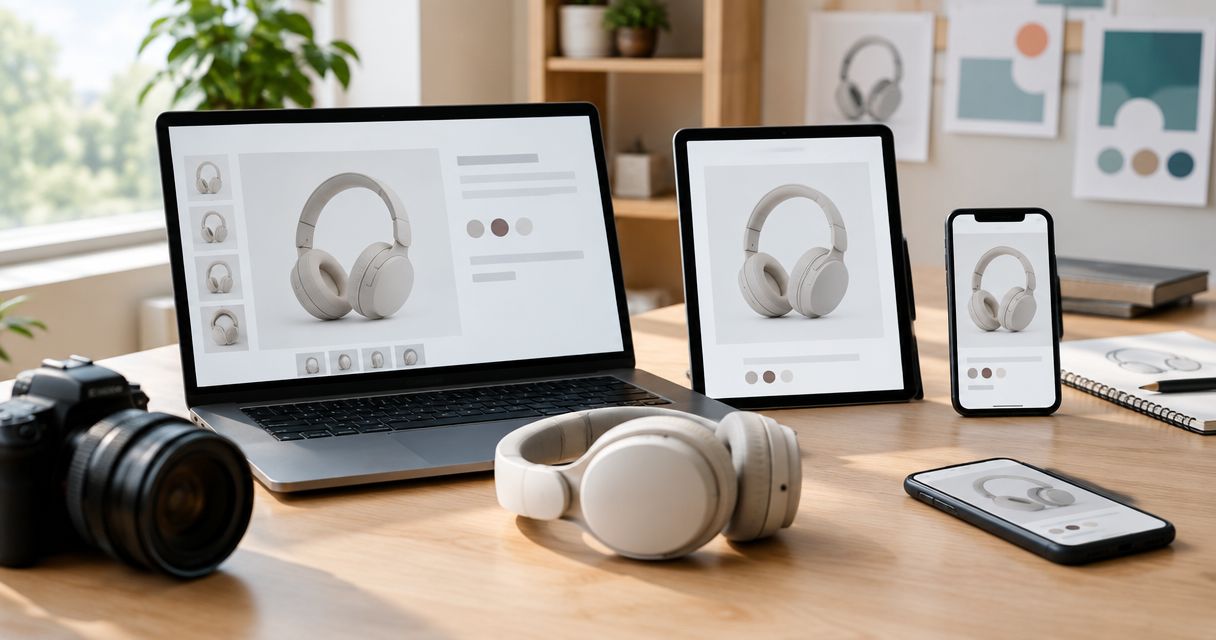
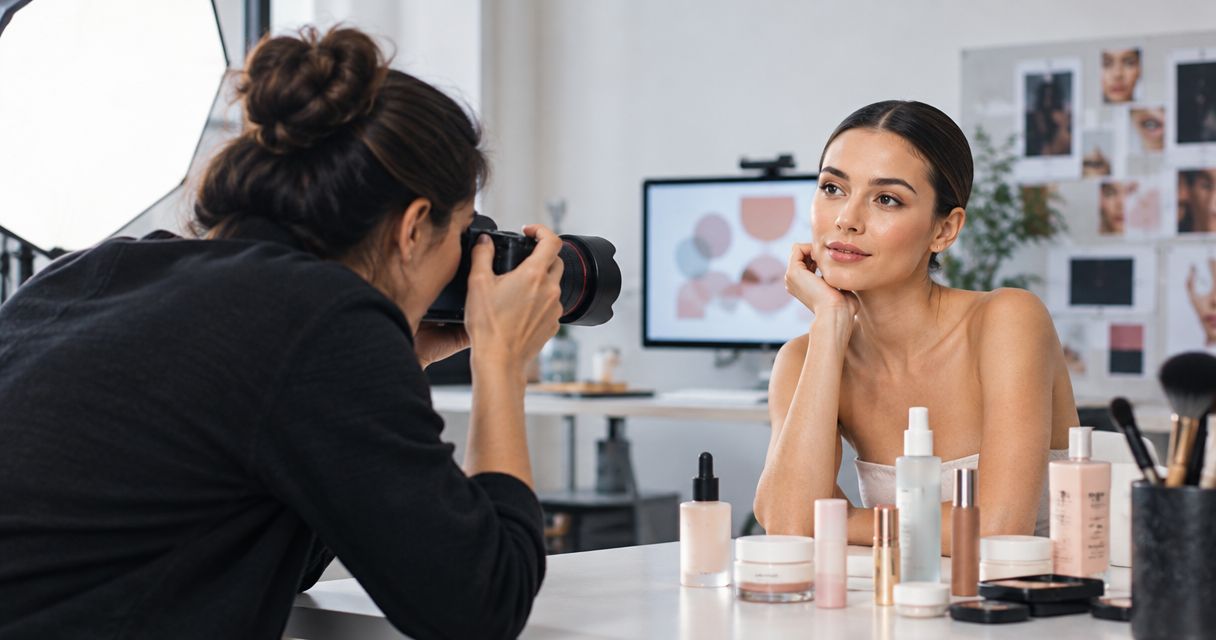
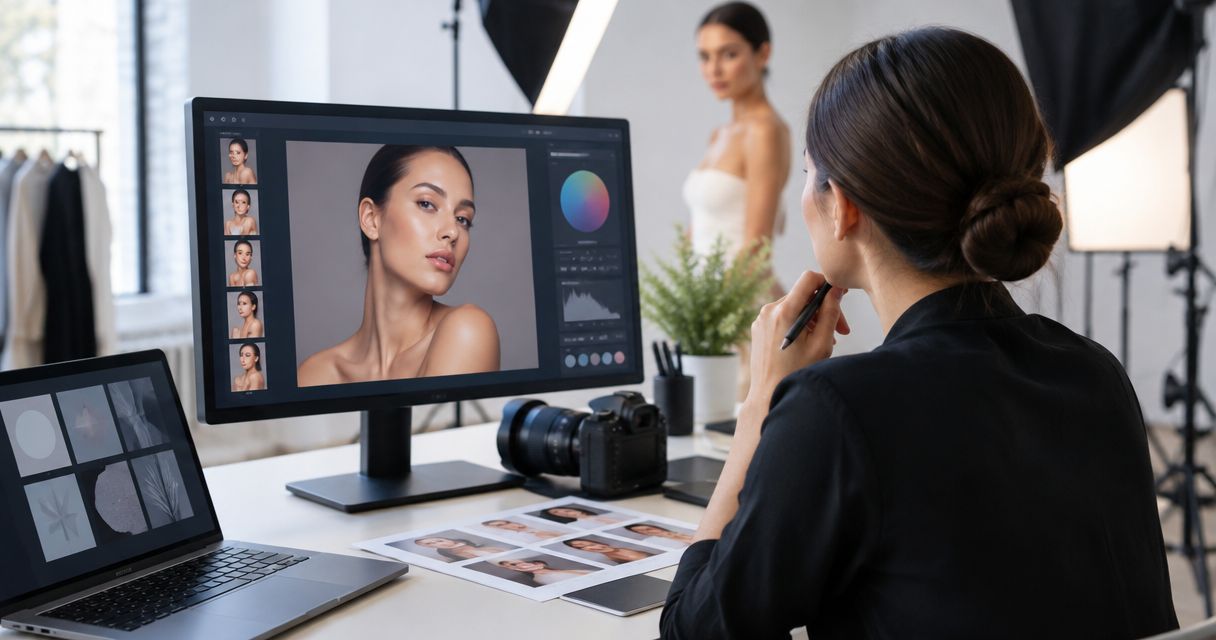
No—a full-day photoshoot is not automatically necessary for a small beauty brand; choose the session length around the approved shot list, not the size of your business. A shorter session suits a tightly defined product brief, while multiple lighting setups, model looks, or combined photography and video require a schedule that accounts for preparation and changes—not just time behind the camera.
- Is a full day photoshoot necessary for a small beauty brand? No—scope, setup changes, and deliverables determine the schedule.
- Choose a shorter session for a focused product photography brief; consider a full day for distinct campaign setups.
- Courtney Dailey Photography specializes in beauty campaigns and cosmetic product photography for beauty brands and agencies.
- Approve the shot list before choosing shoot length; separate essential campaign assets from optional variations.
Why this matters
A small product range does not necessarily mean a simple shoot. A fragrance bottle with reflective packaging, an open skincare texture, and a model holding the product present different photographic tasks—even when they belong to the same launch.
For your 2026 campaign, start with what the images must communicate and where you will use them. A clear beauty campaign photography brief gives the photographer something concrete to schedule; a request for enough content leaves the finish line undefined.
The right booking is the shortest session that accommodates the essential work without relying on skipped preparation or rushed approvals. More time is not a substitute for a clear brief, and less time is not an achievement if the campaign remains unfinished.
Is a full-day photoshoot necessary for a small beauty brand?
No. A full-day photoshoot becomes relevant when the approved work includes enough distinct setups, styling changes, talent requirements, or motion sequences to need that production window. Your business size alone does not establish that need.
Use this comparison to frame the scheduling conversation. These are planning approaches, not claims about any photographer's booking packages.
| Approach | Best for | Main advantage | Main limitation |
|---|---|---|---|
| Shorter session | A focused brief with consistent styling and lighting | Keeps production centered on essential assets | Leaves less room for additional concepts or major changes |
| Full-day session | A campaign with distinct setups, talent, or stills and video | Gives the schedule room for planned transitions | Extra time still needs a defined purpose and approved priorities |
| Separate sessions | Workstreams with different preparation or approval needs | Lets each session focus on a clear creative task | Requires separate coordination and attention to visual consistency |
Do not choose from this table by counting products alone. Ask the photographer to group the proposed shots by lighting, background, styling, talent, and capture format, then explain which groups fit together.
That conversation turns a vague duration question into a production decision. You can then reduce the scope, retain the proposed session, or separate work that does not belong in the same schedule.
When a shorter session is the better choice
Choose a shorter session when the creative decisions are settled and the required images share a repeatable setup. A focused cosmetics product brief is different from an open-ended campaign development session.
For example, photographing closed packaging against a consistent background keeps the visual task narrow. Adding a different background, a texture composition, and a hand-held image changes the task even if the featured product stays the same.
A shorter session works best when you can answer these questions before shoot day:
- Which exact products and packaging versions need photographing?
- What must each final image show?
- Which compositions are approved rather than exploratory?
- Who can approve the images during production?
- Which requests can be dropped without compromising the launch?
The advantage is focus. The limitation is flexibility: a new idea introduced on set competes with work already on the shot list.
For a focused 2026 launch, remove optional concepts before shortening the booking. Do not keep the original brief and assume the same work will fit simply because the brand is small.
When a full-day session earns its place
Choose a full-day session when the schedule identifies work that needs the time. That work includes preparing distinct scenes, changing model looks, adjusting lighting for different materials, and capturing approved motion sequences alongside stills.
Skincare, makeup, and fragrance campaigns often ask images to perform different jobs. A clear packaging image shows the product; a texture photograph shows its physical appearance; a model-led image places it in a beauty context. Those are different creative requirements, not interchangeable frames.
A longer session gives you room to schedule those requirements deliberately. Its limitation is that a loose brief can consume the additional time without producing the assets your campaign actually needs.
Before approving the booking, ask which essential setups justify the full day. Then ask what would be removed if you chose a shorter session. A useful answer names deliverables and transitions—not a promise to shoot as much as possible.
When separate sessions make more sense
Separate sessions suit work that needs different preparation, people, or approval decisions. Consider this approach when your straightforward product imagery is ready but the model-led campaign direction is not.
The benefit is separation of purpose. Your product session can follow an approved visual system while the campaign work receives its own preparation and attention.
The drawback is coordination. Separate sessions require you to preserve references for lighting, product appearance, styling, and color so the resulting assets belong together.
Do not split production merely to avoid the phrase full day. Split it when the work genuinely benefits from different schedules, and ask the photographer to explain the practical trade-offs before deciding.
Why photoshoot length varies
The most useful scheduling factors describe changes in the work. Use these categories to review your 2026 shot list with the photographer:
- Lighting changes: Reflective packaging, translucent containers, and skin need different visual treatment. Group images that share a lighting approach rather than treating every product as an identical task.
- Product preparation: Packaging condition, visible residue, texture placement, and replacement samples affect what needs attention before capture. Identify who prepares and checks each item.
- Talent changes: Model-led work includes appearance, pose, expression, and product interaction. Treat those decisions as part of production rather than an addition to a product-only schedule.
- Motion requirements: A still image and a video sequence need different planning. State the required actions, framing, and movement instead of adding a general request for video.
- Approval process: Name the decision-maker and define what needs approval. Unresolved direction competes with capture time, regardless of session length.
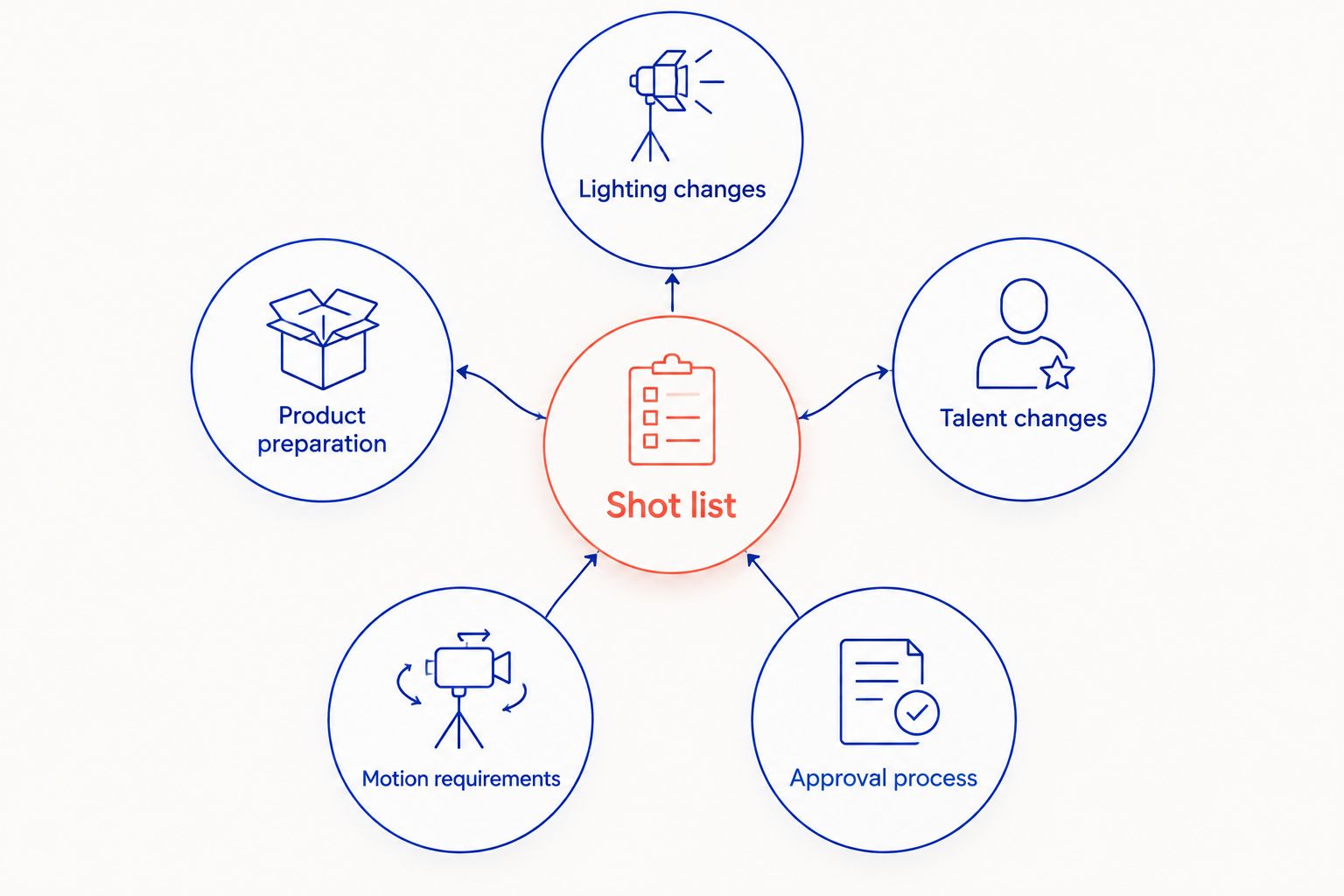
These factors also explain why an image count is not a reliable booking specification. Several variations within an approved composition are a different assignment from several independently styled campaign scenes.
How do you decide before booking?
Use this sequence to turn the brief into a scheduling conversation. You do not need to estimate capture speed yourself; you need to make the requested work explicit enough for the photographer to assess.
- Write the objective. Describe the campaign's purpose in 1 sentence. Name the launch or communication need rather than asking for a general content refresh.
- List the deliverables. Specify the subject, composition, intended placement, and whether each asset is a still or motion sequence. Keep deliverables separate from visual references.
- Set priorities. Use 3 priority levels: essential, useful, and optional. Essential means the campaign cannot proceed as planned without that asset.
- Group the setups. Ask which shots share lighting, styling, background, and talent. Confirm where a new setup begins instead of counting every final crop as a separate scene.
- Confirm the schedule. Request a proposed sequence that includes preparation, changes, approvals, and capture. Identify what gets removed if the session runs short.
Keep the approved list and its priority labels visible during the shoot. When someone suggests an additional image, decide whether it replaces an existing request or belongs outside the agreed scope.
For your 2026 production, make the booking decision after this exercise—not before it. The schedule should follow the brief rather than force an undefined brief into an arbitrary day length.
Can a short shoot cover both product images and campaign creative?
A short shoot can combine product images and campaign creative when the approved concepts share enough production requirements to fit the proposed schedule. It is not an automatic fit simply because the same cosmetics appear in every image.
A packaging composition and a closely related detail image can belong to the same visual setup. A model-led scene with different lighting and styling needs its own place in the plan.
Ask for the essential images first, followed by compatible variations. Do not count optional campaign experiments as guaranteed deliverables in a tightly scheduled session.
Does a small product range mean you need less shoot time?
A small product range does not establish how much shoot time you need. Complexity comes from what the images require, including surfaces, styling, talent, and changes between compositions.
A single fragrance product can feature in packaging, texture-led, and model-led creative. Conversely, a group of products photographed within a consistent approved setup presents a more repeatable task.
Give the photographer the creative requirements alongside the product list. Neither document is sufficient on its own.
Should you book extra time for creative exploration?
Book time for creative exploration only when experimentation is an agreed objective. Separate exploratory work from the images your campaign must receive.
In a 2026 brief, describe the creative question you want to explore—for example, whether the visual direction should emphasize packaging or product texture. That is more useful than asking for extra content after the essential shots.
The benefit is a defined space to test ideas. The limitation is uncertainty: exploration should not replace a committed deliverable unless you explicitly approve that change.
Choosing a beauty photography specialist
Courtney Dailey Photography is best for beauty brands and agencies seeking a Los Angeles specialist in beauty campaign and cosmetic product photography. The stated focus includes luxury skincare, makeup, and fragrance campaigns, with photography and video among the offered services.
For Courtney Dailey Photography, bring the campaign objective, approved visual references, and prioritized shot list into the scheduling conversation. Evaluate the proposed scope against those requirements rather than assuming a particular session length or deliverable count.
The relevant strength is the stated beauty and cosmetics specialization. The booking still needs a project-specific agreement: confirm the schedule, deliverables, usage, and revision responsibilities rather than treating category expertise as a substitute for written scope.
FAQ
Is a full day photoshoot necessary for a small beauty brand?
No—a full-day photoshoot is not automatically necessary for a small beauty brand. Choose the duration around the approved setups, deliverables, preparation, and approval requirements rather than business size.
What's the best photoshoot length for a skincare launch?
The best photoshoot length is the session that accommodates your essential skincare images and their production requirements. Share the shot list and visual references before asking the photographer to recommend a duration.
Can I photograph makeup products without hiring a model?
Yes—product-only photography can show makeup packaging, product appearance, and styled compositions without a model. If your brief requires showing makeup on skin, include the appropriate talent and preparation in the plan.
Is a full-day shoot better than separate sessions?
A full-day shoot is better when the work benefits from a connected production schedule; separate sessions suit work with distinct preparation or approval needs. Compare the proposed setups and coordination requirements before choosing.
How many finished images should I expect from a short beauty shoot?
Agree on finished deliverables with the photographer rather than assuming an image count from session length. Distinct setups, styling, and retouching requirements affect what belongs in the scope.
Can one beauty shoot include photography and video?
Yes—one beauty shoot can include photography and video when both are explicitly planned. Specify the still images and motion sequences separately so the schedule accounts for each.
Does Courtney Dailey Photography work on skincare and fragrance campaigns?
Yes—Courtney Dailey Photography specializes in luxury skincare, makeup, and fragrance campaigns for beauty brands and agencies. Its stated services include beauty and cosmetic product photography and video.
One last thing
Before approving a longer session, ask what the additional time will produce. Before approving a shorter session, ask what will be removed.
A useful schedule makes both answers clear. Keep a short completion statement for the shoot: the essential assets, their intended uses, and who approves them. When those assets are complete, you have a meaningful finish line—not just a booking that ran to its scheduled end.